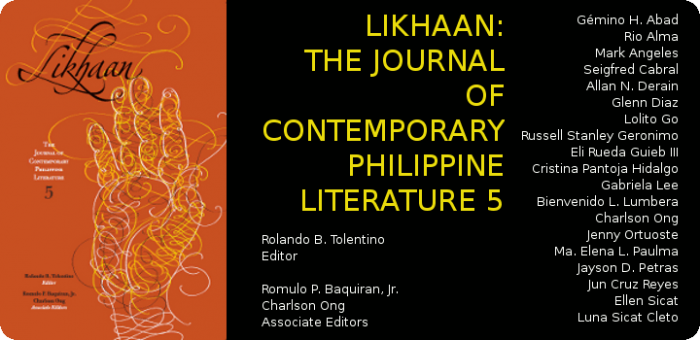
At a time when revolutions are born in cyberspace and global thought
is summarized in hashtags, the artist is in limbo: empowered by a
supposed democratization of culture but now rendered more placeless
(useless?) than ever. And in the advent of a worldwide expression of
rage against greed, who else but the artist must sound the alarm?
The Philippine Collegian, the official weekly student publication of
UP Diliman, is now accepting submissions for its upcoming literary
folio. Short fiction, poems, essays, and graphic fiction in English and
Filipino are welcome. We are also accepting photographs and artworks.
Email your submissions as an attachment (.rtf for texts and .png or .jpeg for images, at least 300 dpi) with a short bionote to kulelitfolio@gmail.com or bring them to our office, Room 401 Vinzons Hall, UP Diliman. The deadline for submissions is March 15.
Marjo and I will be editing! With help from Jayson Fajarda and Caloy Piocos. Submit!
Monday, January 30
Thursday, January 19
Updates.
Stuff:
- Just (b)reached 14,000-word mark on this thing I'm doing. Length-wise, this already satisfies requirement for fiction class, and it's only January (final portfolio due end of March). Bibo, Glenn, bibo. But it's good to know am doing this for personal reasons. That's good, I think. To have a project outside the (v. minimal) things on plate. Of course, will never go around saying, I am working on a novel, because that just reeks of ambition, something can't say I possess. And sounds pompous, too.
- Why I Write / What I Write About Essay due next week. Think might be easy, as will involve mostly masturbatory shit (can be stream of consciousness mode and will be valid form). Although somehow dreading it too because do not have childhood epiphanies of the Oh my God, I want to be writer! variety. Do remember typing out journal entries in an old school typewriter all the time. Also, hope that token mention of Country will not be contrived.
- Thinking about how stories take shape and direction. Can characters really "run away" and "have minds of their own" in manner of Frankenstein monster? Are they clearly formed already even before they act out the first gesture or utter the first line of dialogue? Or are they, from the beginning, already subsumed under a (subconscious) design in one's head, only taking shape as the story goes along?
- Am wary of gutfeel-gutfeel mode in this manner because it is too easy.
- Will be editing upcoming Kule literary folio. Watch out for call for submissions and submit! Theme will most probably be Occupy-related, as the defining call for this generation.
- First raket of the year coming in way late. I know more are coming because of annual report season. But to be honest, starting to feel guilty about sleeping-in-til-noon-then-coming-down-only-to-eat-lunch itinerary of late. Mother not saying anything about it, but sometimes things unsaid ring louder than, say, "Hoy batugan ka, maghanap ka na ng trabaho!" That said, there will be a job fair at school on February 1st. Will probably check it out. But you know: I most probably will not.
- Will turn 26 in less than a month. Not sure how I feel about this.
Saturday, January 14
Hooks.
On Monday, a deadline I had anticipated and for which I actually prepared will elapse. I am kicking myself for missing it. And saying sorry. Over and over. In earnest. Such had been an ongoing lesson: what to do with things that are abandoned halfway, and how does the self deal. Especially considering that such have, maybe unfortunately, become lampposts / buoys / paperweights in one's currently floating, centerless state. That said, is true what they say about doors closing and windows unbolting ajar, as something scheduled for Monday that can potentially be good. Not a good start for 2012, Glenn. Please temper your optimism, as is usually most ideal.
Sunday, January 1
Journeys.
I've since realized that the waking up scenes in what I write betray my preoccupation with one Mr. Samsa; the journeys (on the MRT, the bus, the plane, in distant locations), perhaps a natural reflex to feeling boxed. 2011: a year that was, for so many great reasons, blessed:
1. Silliman
The war-era bus. Noisy and reliable, and really, what can compare to seeing it approach the pick-up bay in Robinsons Dumaguete and you thinking, hey there's our ride.
In the city's paved roads, you sometimes long for a little instability, for wayward branches of trees to invade open windows...
... and the familiar laughter and counsel, and poetry in the morning.
In the Dumaguete airport, waiting for the boarding call you wish would never come.
2. MA still on track
A jeep on campus, because it is becoming harder and harder to leave this place.
Because really, how does one leave UP and its pristine mornings?
3. Going back to guest-edit for Kule
Red Horse by the sea in San Narciso, Zambales during Kule's consolidation activity.
Venn diagram-ing "paghihintay" and "pag-asa" during the post-Christmas party nightcap, a.k.a., Overthinking and Why We Are Perpetually Depressed
4. Davao raket
Boxes of pomelo and priceless first-hand information on the state of education in the ARMM from mayors and aid workers themselves, which leads us to -
5. Freelancing
Breakfast by the sea in Pagbilao, during one of the rakets that thankfully made 2011 - the first full year of doing freelance full time - bearable and really not so bad.
Lunch by the Hundred Islands, after futile attempt to scale a muddy mountain wearing skinny jeans and suede shoes
6. CDO and Philline
Rafts atop a jeep in Cagayan de Oro, during the best vacation of the year, aside from the Bacolod-Sipaway-Iloilo trip with Om in February and the nice gastronomic weekend at LB with the golden couple and Christian.
Tuscany. Echos. Bukidnon, thanks to our host Lina Sagaral-Reyes.
Best work station in the world.
Most trips this year were solitary walks, as freelance and single had been key words; being alone is not so bad, really. Coming to terms with things. We usually have fun.
Especially with this big girl (wearing an oversized Che shirt of all things), who accounts for why Jollibee clips are bookmarked on my laptop
And books.
Especially with this big girl (wearing an oversized Che shirt of all things), who accounts for why Jollibee clips are bookmarked on my laptop
And books.
8. Writing
The whole point of not working full time is so could devote more time to writing. Not sure if year's worth of output is enough and justified. Also not sure how to explain the lola-style balabal in this picture.
And because I am too tired to think of a comprehensive wisdom for the year, here's something from David Nicholls' novel One Day.
"Travelling," she sighed. "So predictable."
"What’s wrong with travelling?"
"Avoiding reality more like."
"I think reality is over-rated," he said in the hope that this might come across as dark and charismatic.
She sniffed. "S'alright, I suppose, for those who can afford it. Why not just say 'I'm going on holiday for two years'? It’s the same thing."
"Because travel broadens the mind," he said, rising onto one elbow and kissing her.
"Oh I think you’re probably a bit too broad-minded as it is," she said, turning her face away, for the moment at least.
They settled again on the pillow.
Now to go back to idle on the bed with this wonderful, wonderful read.
Wednesday, December 28
Paglalagom.
Maayos ang 2011 ko. Mahirap para sa akin ang aminin ito; marahil dahil nahirati na rin sa mga hindi magagandang bagay, at parang pagta-traydor sa mga hindi mapapalad na kaibigan at kakilala ang pag-angkin na maganda ang taon mo. Siguro dahil finite nga ang kasiyahan (tulad ng natural resources), at sa pagkuha ng higit sa nararapat ay waring ninanakawan mo ang iba.
Pero maayos nga ang 2011 ko.
Sa susunod na ang mga partikularidad. Sa simpleng paglalagom, maayos ang naging takbo ng taon. Bago magsimula ang 2011, naalala kong na-interview ko para sa isang raket si Joy Lim, ang wagas na supplier ng charms and crystals sa mga artista. Maswerte raw ang mga Tiger sa 2011. Binigyan din nya ko ng bracelet para sa kalusugan (na ibinigay ko sa Lola ko), at pinaalalahanang laging magsuot ng pulang sapatos at magdala ng gunting. Ewan ko lang.
At sa kaayusan ng 2011, dalawang taon nang magkasunod na maayos, dahil OK rin ang 2010 (at kung paniniwalaan ang ilang Chinese horroscope, magiging maayos din ang 2012 dahil magkaibigan ang Tiger at Dragon). Bahagyang hinihipo ako ng sabik tuwing iisipin ang paparating na taon, dahil mukhang sumasaya ang mga bagay matapos ang pangit na 2008 at 2009. Baka nga nagiging positibo na ako sa buhay. Naku.
*May dalawang taong nagreklamong masyado na raw seryoso ang blog na ito. At nakaka-miss ang LJ. Ako rin, namimiss ko ang kahangalan ng LJ ko.
Wednesday, December 21
Sakuna.
Nasa Cagayan de Oro ako noong Oktubre; sa Dumaguete, noong Mayo. Madali akong mahirati sa mga lugar. Ibig sabihin: madaling mapamahal. Marahil, dahil masarap isipin na may mga bersyon ng buhay Pilipino na umiinog sa ibang lokalidad, sa ibang paraan. Bahagyang katulad ng sa 'yo, pero kakaiba pa rin, kung tutuusin (o bahagyang kakaiba, pero katulad pa rin, sa dulo). Hindi ito romantiko at arbitraryong pag-i-invoke ng "bansa" sa panahon ng delubyo; sa halip, patunay ito, para sa akin, na nag-iisa, kahit magkakahiwalay, ang naratibong hinahawan ng bawat Pilipino.
At nakita natin na ito ay naratibo ng pag-igpaw sa mga sakuna, sa mga pesteng umaalipusta sa "normal" na mga tunghuhin, sa mga karahasang isinasalimpad ng kapalaraan sa araw-araw. At sa mga pangyayaring tulad nito, na kumitil sa higit isanlibong katao, dumungis sa mga lungsod na dati'y walang bahid, madaling mahirati sa emosyonal na tawag ng bayanihan, ng pagtutulungan para sa mga nasalantang kababayan.
Ngunit, lagi't lagi, ipinapaalala sa atin na ang bansa bilang bagay na nahahawakan, nakikita, natutulungan, ay hindi lamang umuusbong sa panahong tulad nito. Pinapatingkad marahil ng sakuna ang mga pakiramdam, pero ang pagiging bansa ay higit sa kawang gawa, labas sa usapin ng minanipulang damdamin. Wala mang kagyat na tulong sa mga nasalanta ang pagpapanagot, marahil marapat usisain: bakit nangyari ito, at bakit dapat umabot sa ganito?
Sa mas konkreto, wagas ang galit ko kay Noynoy sa 'di pagsasalita agad hingil sa isyu. Hindi ko alam kung bakit, pero nang papataas ang bilang ng mga biktima, una kong hinanap sa Google News kung may inilabas na bang pahayag ang Palasyo? May sinabi na ba ang pangulo? Nagpunta na ba siya sa hilagang Mindanao? Sa sobrang galit ko sa kanya, ilang Tweet rin ang naipadala ko kay Abi Valte para magtanong. Anong aral ang napulot ng lideratong ito sa nangyari sa Ondoy? Paanong pinagbawalan si Noynoy na lumipad patungong CDO gayong laksa-laksang media at aid workers na ang andoon sa bukang liwayway ng Sabado? Mukha ba kaming tanga?
At nang, sa Martes, ilang hatinggabi matapos ang trahedyang kumitil sa isanlibong "boss" niya, ay nagsalita na si Noynoy, waring naging SONA't pagbubuhat ng bangko ang talumpati. Naglabas ng ganito kalaking pera. Natulungan ang ganito karaming pamilya. May ganitong kapabilidad na ang PAGASA. May isang maliit na pangungusap na sa unang banda'y umaako ng responsibilidad, pero sa huli'y naging "tayo" bigla ang maysala: "Hindi ko po yata matatanggap na nagawa na namin ang lahat; alam kong may kaya pa tayong, at dapat tayong gawin."
Ang inaasahan ko lamang mula, at hinihingi sa, umano'y ama ng bayan, ay ilang pangungusap ng pangungumusta. Hungkag na retorika, marahil, sa isang banda, pero sa panahong walang sagot ang maraming tanong, nais mo lang ng isang siguradong boses. Na magiging maayos ang lahat. Na maiigpawan ito. Na may amang nag-aasikaso sa mga anak na hilong talilong sa mga alalahanin, hindi nakikisaya nang parang walang nangyari. Nang parang walang mga putikang bangkay na isinasalansan sa minadaling mga libingan. Nang parang walang bansang nangungulila na naman.
Tuesday, December 13
Inuman.
| Mula rito |
Ni Paul Timothy Escueta*
I can drink a case of you, and still be on my feet.
- Joni Mitchell, A Case of You
Pag-inom ng alak ang paborito nating
libangan. Sa Kyusinero sa Matalino St., kabisado na ng mga kuya ang
hilatsa ng pagmumukha natin at paboritong pwesto. Kasabay ng pagsayad ng
puwit sa upuan kung ilapag nila sa mesa ang bucket ng Pale Pilsen.
Tapos ash tray. Tapos tissue. Tapos Pulutan Platter A, na may
sari-saring pika-pika, gaya ng French fries, calamares, nachos, chicken
lollipop, at pipinong lumalangoy sa suka.
“Kamusta love life?” tanong mo.
“Um, kamusta ka ba?”
“OK naman.”
“Edi OK ang love life ko.”
Pero syempre sa kalagitnaan pa ng inuman
uusbong ang ganitong mga usapan. Kailangan munang paspasan ang ilang
bagay sa simula: ang pag-aaral, ang Kulê, ang Peyups, ang girlfriend mo.
Ang dami na ring babae sa buhay mo ang
mas natagalan ko, banggit mo minsan, habang nakangisi. Wala ka naman
talagang ibig sabihin dito; may mga sandali lang talagang dinadapuan ka
ng lambing, at ako ang nasa iyong tabi. Punong-puno ka kasi ng pag-ibig;
kaya minsan, kahit hindi mo sinasadya, may mga napapadpad sa aking
direksyon.
These things that are pleasin’ you can hurt you somehow.
- Eagles, Desperado
Naaalala mo ba noong nasobrahan tayo ng
inom minsan – tig-siyam na bote ‘ata – at sa pag-ba-bike mo pauwi ay
bigla kang nasuka? Grabe pa rin ang balance mo at tuloy-tuloy ka lang sa
pagpepedal, kahit minumura ka na ng mga tambay sa tabi ng daan na
natalsikan ng suka mong may pira-pirasong patatas at pipino.
Ako, hindi marunong mag-bike, at sa
una’t huling beses na sinubukan mo ‘kong turuan, ang una mong paalala
ay, “Kailangan mong mag-let go, Paul.” Literal ang ibig mong sabihin,
pero hawak mo kasi ang likod ko at hinihipo ng amihan ang ating mga
pisngi, kaya iba ang sumagi sa aking isip. Lalo na nung kinagabihan sa
Kyusinero’t sinabi mong, “Siguro, kung babae ka, mag-se-sex tayo
mamaya.”
Puta naman. Walang ganyanan. Lasing na
lasing ka na nga marahil. Sinabi mo rin kasing maganda ang gupit ko, at
bagay sa ‘kin ang maikling buhok. Kulang na lang, sabihin mong ang cute
ko, at “Pa-kiss nga.” Sa kasamaang palad, nawalan na ng malisya para sa
akin ang mga ganitong tagpo’t palitan. Hindi ba sabay nga nating
pinanuod ang video ni Hayden Kho at panay ang batikos mo sa performance
niya?
“Guess she gave you things I didn’t give to you.”
- Adele, Someone Like You
Like what? A vagina?
Biro lang. Alam mo namang hindi ako
rah-rah sa gay cause, pero noong gabing iyon, naisip ko sa kauna-unahang
pagkakataon kung papaanong humahadlang sa mga gusto natin ang ilang
bagay na dala lang ng simpleng pagkakataon, gaya ng gender. Sabi nga ni
Chokoleit, “Para ‘yun lang?”
Pero sinabi mo dati na naniniwala ka sa
reincarnation at past lives, at baka nga mag-syota tayo sa dating buhay
natin, o sa susunod. Ewan. Marahil naaalala ko lang ang isang lumang
pagnanais na maging higit pa sa kaibigan mo. Pero para saan pa ba ang
alak kung hindi sa panandaliang paglimot sa mumunting kirot? Hanggang sa
susunod na inuman.
*Walang kwentang pagkubli.
Wednesday, December 7
Piolo.
Closet Quivers*
Glenn L. Diaz
But outside good-natured Pinoy humor, the debacle revives age-old questions regarding the real state of the LGBT sector in the country. For while surely, “winning” the heartthrob to the gay cause might prove to be a step forward, the reaction that his potential outing spawned reveals that it isn’t as clear-cut as that.
Glenn L. Diaz
All we need to know in this unfolding
narrative are these: there was a crying girl, an ex-boyfriend, an
emotional breakup. The girl, they say, is pretty, although a bit
mannish, excused by the fact that she is cut from showbiz royalty. The
ex-boyfriend is the “ultimate heartthrob,” although whispers had long
persisted that it’s not exactly vaginas he has been causing to throb.
Throw in a bespectacled host’s series of
“deretsong tanong” on a lazy Sunday afternoon and we had the makings of
a veritable Pinoy saga; one for the books, apparently, evidenced by the
fact that it was inescapable, rivaling news of a former president who’s
on the brink of incarceration and at one point becoming a trending
topic on Twitter worldwide.
The implications of this saga are
multifaceted, but the trajectory of the jokes that it birthed appears to
be one-tracked. There is a reference to another actress, who married an
actor who turned out not only gay but, some say, even prettier than
her. There is a joking speculation as to the heartthrob’s real motives,
and some say he just wanted to get close to his ex-girlfriend’s
goodlooking, if not morally ambiguous, father.
But outside good-natured Pinoy humor, the debacle revives age-old questions regarding the real state of the LGBT sector in the country. For while surely, “winning” the heartthrob to the gay cause might prove to be a step forward, the reaction that his potential outing spawned reveals that it isn’t as clear-cut as that.
‘The reign of telling secret’
That the whole saga is unfolding before
the public eye at a time when social media had enabled the unbridled
sharing of opinion has, in so many ways, blown things out of proportion.
“To the fine antennae of public
attention,” writes foremost queer theorist Eve Sedgwick, “the freshness
of every drama of (especially involuntary) gay uncovering seems if
anything heightened in surprise and delectability, rather than staled,
by the increasingly intense atmosphere of public articulations of and
about the love that is famous for daring not speak its name.”
And so while there may be undeniable
strides in the way homosexuality is displayed and perceived, it doesn’t
diminish the seductive nature of people being yanked out of the closet.
In the case of our heartthrob, the idea of his outing seems utterly
irresistible, at least judging from the rabid, almost vitriolic calls
from all sides of cyberspace.
The mob-like desire has ready
justifications, too: that, for one, he reduced his ex-girlfriend to
tears on national television; and, two, that he is a public figure and
therefore fair game for butchery and accusations.
‘On their own’
But we simply don’t have the right to
out other people, says J. Neil Garcia, UP professor and renowned
expert on queer theory.
“We need more masculine representations
of gayness … to balance out the sissy stereotypes that local showbiz is
constantly dishing out, but even then, or precisely here, the ethical
question regarding outing remains utterly germane.”
“The wish, of course, is for more and
more masculine gay men to come out on their own – in mass media, if
possible, since its stereotype-countering effect will simply be more
potent, by virtue of the nature of mass media themselves. But we simply
cannot out these guys. They need to come out on their own.”
Tangentially, the particularity that the
case brings to the discourse hinges on his construction as a “bankable
actor” and the changes, if any, that his outing will result to. There
are speculations, to cite, that while the ex-girlfriend’s tears were
true, there was still an attempt at damage control, which explains why
the interview was taped to begin with, contrary to how most sensational
tell-all’s are conducted.
It is interesting, therefore, to note
how mass media, while largely profit-driven and prone to typecasting,
can in truth serve as a vital platform in which to break the stereotypes
it had contributed to perpetrating to begin with.
Sadly, judging from the jokes in the
aftermath of the interview, including all the name-calling and the
homophobic slurs, our heartthrob is not breaking any stereotype. The
stereotypes are instead being hurled pointblank against him.
‘A defiant move’
Outside the glitz of showbiz, however,
what steers the very premise of outing is heterosexism. Outing announces
unequal power relations. To weaponize a potentially liberating act is
premised on the belief that someone will fear being outed
because it is a demotion, a downgrade. To threaten a public figure with
being outed is to equalize homosexuality with the risk of utter
downfall.
But voluntarily coming out of the
closet, instead of being forced out of it, is a defiant move. It
demonstrates a steadfast bravery that knowingly exposes one’s self to
stigma. After all, outing demands resocialization; a paradigm shift from
the “default” heterosexual identity with which everyone is raised. And
so implicit in the act of coming out is the rejection of the ideology
that posits the primacy of heterosexuality as the only acceptable
orientation.
That may be true, and it probably is,
but to end there is to ignore the larger issue with which the supposedly
private love story is laced.
Because in our heartthrob’s case, coming
out of the closet seems to offer very little incentive. Given the
slightest chance at hating, there are those who pounce, instantly and
with little deliberation. So for as long as people have a good reason
for staying in the closet, we understand that our heartthrob will need
to maintain his handsome silence.
*Apologies to J. Neil Garcia
Sources:
Hunter, Sky. Coming out and Disclosures, Routledge, 2007.
Sedgwick, Eve. Epistemology of the Closet, University of California Press, 1990.
Monday, December 5
Novel-writing.
Let it be said for its absurdity: I am trying to write a novel. A month ago, this would have sounded preposterous, but see what an academic requirement (and therefore an unsaid threat of a middling grade) can do? B had given us an option to do a novel in lieu of the 40-page short story he normally required. It is suddenly doable. For some reason, it suddenly seems something I can actually do before I turn 27 (because Rizal published Noli at 26, and I have serious competitiveness issues).
It was a good thing then that I got to read nice novels in the past month or so, including Egan's A Visit from the Goon Squad, Franzen's The Corrections, and Atwood's Alias Grace (and a fantastic nonfiction book on the Rwandan genocide from L). Fat novels. I am clearly still learning how to do this. The largeness. The worlding. The measured pace. The requisite depth of introspection. The Proustian detailing. The nouns. I just passed the 6,000-word mark, which puts me at 7.5 percent of my set 80,000-word target (it actually sounds something when you put it in percentage).
Since my workshop slot is somewhere in the middle of January, I have around 5 weeks to churn up around 5,000 more. But since I want to take advantage of the rare chance to have B critique a novel manuscript, I obviously want to do more. I have set up a modest 1,000-word-a-day requirement for myself, something that is turning out to be not so modest after all. It is hard. I write quickly when it's for work and critical papers, but when it's this -- and I, like B, am relying for the most part on gutfeel and a hazy plot in my head - I am absolutely slow. And with my obsessive need to reread and rewrite, I am taking ages. These, of course, all considering that I have very little social life and absolutely no professional life, other than guest-editing for the Collegian, to speak of.
Do I harbor delusions that it might be a nice piece of literature? Well, I don't know. But otherwise, what would be the point?
Wednesday, November 30
Monday, November 28
Cubao.
Wrote this essay for my nonfiction class. Two nights ago, met up with Melane and Victor. After dinner at My Thai, we had DQ blizzards and found ourselves standing-sitting by the rails opposite Shopwise. Cubao. O Cubao.
Cubao
Born and raised in Manila, I am accustomed to its noise, its quotidian chaos. Once or twice, when its violence unnerved me, I found myself wishing I lived in Bacolod or Dumaguete or Roxas instead. Slow cities. And calmer, birds chirping in the morning and crisp air that sharply fills the nose. But after a few days there, I would crave for the madness of Manila. The roaring engines. The reek of diesel. The itinerant vendors hawking their wares. In my city, there are busy intersections that, with neither traffic light nor cop, would witness no road accident for years on end. Foreigners call it Third World disorder. I call it skill, a temerity, a spider sense-like keenness that one acquires after living through the mess. If my city were my room, I like its comforting disarray. I know where everything is.
But
a woman sitting across me on a jeepney one night panicked and writhed
helplessly in her seat, freshly realizing her purse was slit open, her face misshapen
under the red glare of the jeep’s tiny incandescent bulbs. The following day, a
bomb ripped through a bus along EDSA, killing five and severing several pairs
of legs. I was reminded of Pierre Bourdieu, my best friend during my
theory-lathering days with the Philippine Collegian, UP’s student paper. Violence
is harshest when it is most normalized. Violence is most effective when it is
made invisible.
This
violence of the everyday, the everywhere is most palpable in a place like
Manila. The traffic, the pollution, the off-chance that the bus you’re riding
will explode into smithereens one innocent Tuesday. That bombing rattled me,
its sheer nearness. The bus exploded a few meters away from the Buendia station
of the MRT, just outside the stories-high earthen walls of posh Forbes Park. I take
that route every once in a while, coming from Makati for a writing assignment or
from Batangas for a quick getaway to the beach. And so I realized it could have
been me or many of my friends who work in Makati. I remember mouthing a silent
prayer, then, and soberly thinking, we are survivors all.
These
days, as a graduate student, my normal route is from my house in Manila to UP
in Quezon City via the Aurora Blvd and Katipunan route. Every time I make that
trip, I pass by Cubao, the bustling geographical center of the metropolis. For
many wide-eyed adventurers and desperate breadwinners from the province, Cubao
is their first real glimpse of the big city, its grimy bus terminals and impure
air, its incessant noise and unlawful song. For city dwellers, Cubao is just
Cubao. It is there, just like the city, not to be scoffed at or rebuked, but
merely to be endured.
I wonder
then if I’ve been made immune – enamored, even – to a violence that is rendered
unseen by its ubiquity. There is no question: I love my city. But does it love
me?
In
Cubao, for instance, there is always a need to shout above the din.
“You
cannot hear yourself think here,” yelled my friend Kris, a college instructor
and Cubao resident for all her 22 years. It’s something a foreigner would say,
I shouted back, if said foreigner were similarly sitting on this busy Aurora
sidewalk in between parked motorcycles and cars, observing. The British edition
of men’s magazine Esquire recently came out with a piece on Filipino cuisine
and, tangentially, navigating Manila’s streets. It reached a pleasant enough
conclusion, but in prefacing the revelation, the Philippine capital was called,
among others, “a fucking armpit,” “a hell-hole,” “a city with a pockmarked face
and a horrible limp.” How unkind, I thought, but in the middle of Cubao,
surrounded by grime and seeming lawlessness, I had to admit: it wasn’t
completely unmerited.
In
a National Geographic documentary, where the host visited the slums built atop
graves in the South Cemetery and the communities inside the Muntinlupa City
Jail, Manila as a city was lauded for its – generous euphemisms, aside – “energy.”
There
was, of course, a ready defense, as any Filipino with a cursory knowledge of
history should know. Manila was the Orient’s first true melting pot.
Aggressively traded with its Asian neighbors, then colonized by Spain for more
than 300 years. In its 1945 liberation from the Japanese, it was leveled to the
ground, government buildings and churches and schools, along with the priceless
gems inside that date back to its founding 420 or so years ago. In the
month-long devastation, almost everything was lost, irretrievably, the severe
insult to the injury that was the 100,000 death toll.
What,
then, of ugliness? We were victims of
history!
A
few meters away from where we sat, a locksmith idly tinkered with some random
lock, his gamut of keys and tools laid out like many little trinkets for sale.
The signage advertising his trade is darkened by soot. He’s been there, he
said, in his little, dark corner of Cubao for more than two decades now. In
throaty Filipino, he added, “Nothing has changed.”
What
has not changed is this: there is always a bottleneck in Aurora Blvd approaching
EDSA, always a parking lot situation along the underpass, always some obstinate
jeep in the middle of the road going to E. Rod. From Araneta Center, there is
always a long line of jeepneys waiting to exit and dissect Aurora, from that
narrow street between Aurora Tower and Mercury Drug to that even narrower road on
the other side, where dingy gay club Palawan is across the similarly decrepit
beer joint Bang-bang Ali. More cars crawled elsewhere, on the street where the bawdy
“European-inspired” inn Eurotel fronts the gold-decked worship building of the Universal
Church of the Kingdom of God (in the right rooms in Eurotel, you part your curtains,
and the first thing you’ll see is one of the several bible verses inscribed on
the Christian building’s walls). All around: piles of trash, bevies of scantily
clad girls in the midst of negotiation, a vagrant or two. Overhead, one of the
busiest train stations in the city looms over the road it tried to decongest, the
pall so depressing and permanent, black wires dangling like wayward pasta, the
medium-rise structures caked with grime.
What
has changed is this: a few minutes’ walk away, in glimmering, upscale Gateway
mall, there are places like Cibo, Italianni’s, and Gumbo, which offers “a taste
of New Orleans.” There’s Burgoo, Café Adriatico, Kenny Rogers, Krispy Kreme, Le
Coeur de France, and the first and one of only two Taco Bell in the country.
Posh hotel chain Mandarin Oriental has even set up an al fresco café and deli
right smack in the middle, complete with palm trees and various terra cotta greenery
that cut across all five floors. Gateway is a pocket of First World in Third
World Cubao, while Mandarin is a pocket of nature in the pocket of First World:
both are artificial and contrived.
The
Aranetas, the clan whose war-era industrialist patriarch Don Jose Amado found
the original, radio antennae- and grass-strewn 35-hectare plot on the outskirts
of Manila, are trying to catch up with the pace with which the other families
have galvanized their turfs. Let’s face it. Makati had become Makati and
Ortigas had become Ortigas, while Cubao, well, remained to be Cubao. Left out.
Lowly. But with the slew of infrastructure projects in the pipeline, Jorge
Araneta, Don Jose’s son, is promising a “renaissance.” Manhattan Garden City,
its flagship residential project alone, consists of 18 high-rise towers, 3 of
which have already opened. Set to be the pièce de résistance, a giant
communications structure called the Manila Tower is envisioned to rival Paris’
Eiffel in height, grandeur, and iconic evocation.
“Sir, if you go to Cubao
nowadays, it’s had a major refurbishment from the old and scary, decrepit place.
It is now
being managed and developed by Megaworld Corporation. The area is flood free
and now very safe.” This is the promise of real estate broker Karen
Manangquil, who’s affiliated with major property developer Megaworld. She’s
part of the squadron of annoying, fake-smiling, flyers-bearing, heavily made-up
boys and girls who accost unsuspecting shoppers walking along Gateway’s crowded
aisles. If they hand you a flyer and ask for a minute, it means you: (1) look old
enough to be a home owner, and (2) appear rich enough to afford the price tag
that comes with a unit, the lowest pegged at P2.3 million.
Or,
she later stressed, you evoke that inimitably magnetic OFW vibe.
The
Araneta group is injecting a multi-billion peso investment to try and
reconfigure Cubao into an urban enclave similar to the flourishing Bonifacio
Global City in Taguig. After all, Araneta Center was a pioneer mixed-used
complex not just in the Philippines but in the world. In the 1960s and 70s, Araneta
Coliseum, Ali Mall, Farmers Market, and Fiesta Carnival were all, to a certain
extent, notable: biggest indoor stadium, first enclosed shopping center,
biggest wet market, and first entertainment center of its kind.
But
if the Fort is accessible only by private vehicles, cabs, and the occasional
yuppie-filled Fort bus, Cubao is found on the signages of scores of public
utility vehicle, from jeeps plying nearby Quezon City Circle to buses traversing
unpaved roads in far-flung Tabaco in Albay. Two elevated train lines run
through it: one, through the city’s main artery, the other, leading to the
University Belt. Jeeps: to Libis, Taft, Cainta, Fairview, Cogeo, Quiapo, Antipolo,
Kalayaan, Angono, Divisoria. City buses: to Baclaran, Letre, FTI, Tungko,
Sucat, Malanday, Leveriza, Alabang. Provincial buses: to Baguio, Bangued, Tuguegarao,
Naga, Laoag, Tabaco, Lingayen, Catarman, Catbalogan, Iba, Aparri.
Cubao
is the byword for accessibility. It is democratic. It is egalitarian. My best friends
from college, who come from Marikina, Taytay, and Novaliches, and I, from
Manila, often compromise and make do with Gateway. We are not alone. Data from
the Metro Manila Development Authority say daily pedestrian traffic on the
EDSA-Aurora Blvd footbridges exceeded 150,000 in 2009, the third busiest in the
metro. By Araneta Center’s estimates, close to 1 million of Metro Manila’s 11
million people visit its premises every single weekday, even more on weekends.
Cubao is no-frills. Cubao is people.
And
in the eye of the enterprising capitalist, people means profit. If consumerism
is a cornerstone of capitalism, Cubao is a pioneer, too. It paved the way for
the rabid, large-scale consumption that we know today, with our midnight sales,
billboard-laden skies, and the predictably impossible traffic in the vicinity
of malls. The now worn-out Rustan’s in Araneta Center used to be Rustan’s
Superstore, the first time a department store and a supermarket were combined.
SM in Cubao was the second to open after the original branch in Quiapo. And as
this country’s history of consumerism is almost, I would argue, concurrent with
the history of Henry Sy’s empire, Cubao is, once again, a veritable forerunner.
It
makes sense, then, that when it started to lose its mall-going public to Makati
and Ortigas, Araneta Center came up with Gateway.
My
friend Scott, a Denver native who now curiously lives in a street in Cubao
called Albany, told me over coffee how surprised he was at the centrality of
the mall in Filipino life. Sipping his half-decaf latte in one of Araneta
Center’s three Starbucks, he said where he came from, “most [malls] are found
on suburban real estate lots. No more than two floors, usually just one. Can
you imagine that?” Gruffly, he added that malls in the US have free parking.
I
noted that the nucleus of communities in the Philippines used to be the plaza,
flanked by the church and the town hall. Does this, I wondered out loud,
indicate a shift in the prevailing value system of Filipinos, from theocracy to
blatant consumerism? Not quite used to polysyllabic words that end in ism, he added
that e-commerce had not been kind to American malls.
The
goal, it seems, is to make malls vital, instead of optional. They are placed
where volumes of people predictably amass, taking into account foot traffic and
transportation routes. Insatiably, they extend endlessly, a monster eating
everything in its path. SM in North EDSA, the biggest in the country and third
world-wide, used to be just SM North EDSA. Today, there is The Block, The
Annex, North Link, Warehouse, and the Sky Garden. Communities have risen out of
malls. From them, high-rise condominiums emerge, promising to put all of modern
man’s needs under one roof: shelter, dining, leisure. The malls of today offer
beyond the customary trades. One can go to a mall to hear mass, view art
exhibits, get a perm, buy a book, get a haircut, attend class, deposit a check,
get your laptop repaired, attend a convention, even breast feed your baby or
undergo minor surgery like liposuction.
But
even without Gateway, Araneta Center has embedded itself into the Filipino
psyche with Araneta Coliseum. Two spectacles that perpetually bewitch the
Filipino mind – basketball and beauty pageants – have found homes in the Big
Dome (recently renamed Smart Araneta Coliseum in yet another not-so-subliminal
encroachment of big business on cultural iconography). Leagues: the Philippine
Basketball Association, the University Athletics Association of the Philippines,
and the National Collegiate Athletic Association. Pageants: the annual
Binibining Pilipinas and the one time Miss Universe was held in the country in
1994. Those who have graced Araneta Coliseum include Bon Jovi and Andrea
Boccelli, Kylie Minogue and Akon, Nat King Cole and Kobe Bryant, Lady Gaga and
Pope John Paul II. Having come from UP, I’ve been making a trip to Araneta at
least once a year since 2002 for the UAAP Cheerdance Competition. Its 2008
edition attracted a record crowd of 23,448 people, unsurpassed by any PBA
Final, Ateneo-La Salle game, or Sarah Geronimo concert.
Cubao,
then, is inextricably linked with the Filipino city, the Filipino sense of
entertainment, which is fine, I reasoned, except when such connection is commodified
and taken advantage of. For instance, desperate for Cheerdance tickets and my
Collegian press ID powerless in the eyes of Big Dome management, I succumbed once
or twice to scalpers, who sold general admission tickets at 1,000 percent
mark-up, from the original P50 to P500.
Conscience-deficient
human beings aside, in Cubao’s margins lie places and things that has endeared
it to an entirely different market and sensibility. Cubao Ex, the former
Marikina Shoe Expo, is on the fringes of Araneta Center and has attracted a
new, almost hip crowd. The close-knit, village-like complex is shaped like a
horse shoe and plays host to specialty restaurants, art galleries, and stores selling
the strangest, most fascinating things: old chandeliers and telephones, funky
clocks, vintage wrist watches, antique furniture, secondhand books, old comic
books, wooden sculptures, bargain shoes, and one-of-a-kind graphic tees. At
night, the unofficial banner spot in Cubao Ex is Mogwai, a restaurant cum drinking
joint cum events place. There is always something happening in Mogwai: Peter
Folk films on the cozy screening room at the second floor; reggae band Brownman
Revival performing upfront; or filmmaker Kidlat Tahimik, a regular, guzzling
his bottle of Red Horse. With its battered marquee-style signage, mismatched
furniture, fabric-lined mini-chandeliers, and employees cheekily named
Mogwaiters, Mogwai’s vibe is the closest I can find to that of Sarah’s, the
iconic drinking place on the outskirts of UP in Krus na Ligas. In Sarah’s, where
on certain nights you’ll find yourself sitting beside a National Artist or a
famous band vocalist, the ambiance is bring-your-own-ambiance. In Mogwai, with its
yellow-tinged lights and quiet whirr of conversation, the ambiance is gentle
and laidback. This, while a few kilometers away, Cubao raged on until the dead
of night.
“Sinong hindi mai-inlove sa
Cubao sa gabi? Malakas ang appeal, mahirap matimpla, maraming lihim. (Who will
not fall in love with Cubao at night? Its appeal is intense, it’s hard to
figure out, it’s got secrets.) ” This is Mixka, a playwright whose Streetlight
Manifesto was recently staged in Tisch School in New York. During our Collegian days, we
held section meetings in Sarah’s. After graduating, Mogwai is a top choice
during meet-ups. But already, the more protective of the Cubao Ex regulars feel
that their haunt, after being deigned “cool,” is now being invaded by wannabe
hipsters who just want to be seen.
Conflict. Cubao is witness
to constant conflict. “Cities,” wrote urban theory scholar
John Short, “give physical expression to relations of power in society.” In
Cubao, the air-conditioned LRT coaches run above the din and confusion of Aurora.
In Gateway, the most high-end shops are found on the top floors. In Araneta
Coliseum, the expensive patron seats are closest to the action. In Cubao,
things go progressively worse from the center. From traffic to air quality,
from roads to dining options, from waste disposal to security. Absent my
romanticizing gaze, Cubao is a landscape that typifies the deep-seated
stratification of Filipino society. I am tempted to use “microcosm” here, but
such will be erroneous: there are no factories in Cubao, no farmers, no
fishermen. Even the development theory of dependence (positing center-periphery
power relations) is inadequate, as Cubao is not a site of production, but mere
consumption.
I
am prone to nostalgia, and I can easily invoke childhood memories of going to
Fiesta Carnival or anticipating the puppets at the COD display during
Christmas. After witnessing my first pickpocketing incident, however, I
realized that nostalgia is useless without engagement. Plunged headlong into a
life – student then, now professional – that is cutthroat and obsessed with achievements,
the city I move around in is typically bypassed and excused as inherently chaotic.
Of course, traffic is horrible. This
is Manila. Of course, the streets are
not safe. This is Manila. Of course,
there will always be poor people. This is the Philippines.
But
the invisible violence in my city is suspect, possibly defended by institutions
that are supposed to dismantle it. For instance, the MMDA, faced with the
gargantuan task of easing Manila traffic, thought of footbridges (its color – from
pink to green – changing alongside dispensations). Once separated, MMDA argued,
both vehicular and pedestrian traffic would flow unhindered. Commuters would
perhaps disagree, burdened as they are with the need to climb an extra flight
of stairs or walk an extra 10 meters or so to and from landings. Motorists, on the
other hand, are spared from one delaying traffic light. This bias is despite a Metro Manila Urban
Integration Study revealing that 84 percent of all
trips in Manila are made via commute or walking, with only 16 percent made
using private vehicles. If 4 out of 5 people then are pedestrians at one point
in their journeys, shouldn’t policy concerning urban space take them into
account?
Exclusion.
Cubao seems to be the everyman of places. There’s something for everybody. For
Kris, there’s the reassuring noise; for the locksmith, there’s the possibility
of business; for Karen, there are condo units to sell; for Scott, there’s
gourmet coffee and semblance of First World amenities; for Mixka, there’s
allure and mystery. For me, there’s the realization that as with all things deafening,
it is better, in the case of Cubao, to examine its silences. The exclusions it
makes. The larger system that permits it.
During
the time of the EDSA bombing, I was in the thick of writing a paper on a
collection by the poet Mabi David. You
Are Here is an interrogation, at once historical and personal, of the
Battle for Manila. It purposely collides the two, and the result is a
crystallized understanding of the crucial junction. Its central thesis – which
asks if future generations, safe from the crossfire of battle, can rightly
claim solidarity with their ancestors based merely on being born on the same
city – has been an ongoing preoccupation for me as an aspiring fictionist and
poet. Some realm of experience, I realize, have more ramifications than others,
and I’ve constantly wondered whether those that identify me – my “exotic”
Filipino roots, my “alternative” sexuality, even the long history of my people
– is ethical material for the written word; whether everything, really, is fair
game.
In
this manner my city becomes material, inevitably: as in writing as in life.
And
so in negotiating what I feel for my city, I also clarify my stance as a
writer. On one hand, I feel its violence; on the other, I recognize the only way
to survive is to embrace it, like the 11 million dwellers who wake up at 6,
brave the early morning commute, work for the better part of the day, then
brave rush hour traffic at night for a little respite, before doing the same
thing again.
On
the way to Cubao Ex one typical Saturday night, I noticed that the Araneta
Center Bus Station had been transferred. The area where it used to sit is now
cordoned off, the high fences draped in tarpaulins vowing great things to come
for Cubao. The sound of heavy machinery, near-indistinguishable from the impatient
honking and engines raring to go, forebodes of something that operates like
clockwork . The violence, just like Cubao, never sleeps.
Thursday, November 24
Victory.
'My child, we have won'
Won: because it is war. It is bloody. There were casualties. There were spoils. And child: because it has gone on for generations. Because it has gone on long enough.
That said, there is little to gain in romanticizing the Supreme Court's decision to distribute the land of Hacienda Luisita to its farmer-beneficiaries. The machinations of the the powerful are complex, and their ways are many. There are accusations that the decision is more vindictive than just; an attempt to spite rather than to end -- and begin -- a too long a saga to give people what is rightly theirs.
We will never know: what it's like to work ten-hour days for P9.50, to have the sun on your back and neck and arms, to have sweat drop from your brow to the arid land, and to bear the unkind knowledge that this life -- of so little joy -- will also be your children's life, and their children's life, and so on. We will never know.
And so we cry. We, well-meaning middle-class city folk who have neither planted nor harvested a sugar cane in our lives. In our comfortable posture chairs, in our carpeted offices, our twin beds, in our shelves with a history book with a cursory chapter on feudalism, and in our classrooms that echo an indignant rejoinder to a classmate who found the cinematography of "Sa Ngalan ng Tubo" too bright.
But once or twice, our journeys may have brought us to places beyond our comfort zones, our perfect worlds. It doesn't take a lot -- in fact, a mere opening of eyes, the upturning of ears -- to see and hear what had been normalized, what some attempt to disguise. In Hacienda Luisita, there are mini-chandeliers in the McDonalds outlet. Kris Aquino, the "queen of all media," had said, with absolutely no remorse, that her jewelry are "katas ng Luisita." The hacienda is two and a half times as big as Makati.
While this victory is not ours, us in our trifling motions in our uninhabitable cities, let us bask in it for the future that it conjures: a society where grueling work is afforded grueling gifts.
Wednesday, November 16
Anger.
So: Student leader disrupts Clinton forum in Manila
The terrain of US-RP relations is a tumultuous one. We need not look too far to realize that Uncle Sam's hand is a long, sticky tentacle; that indeed when the US catches a cold, the Philippines sneezes. And so do not tell me about civility and there being a proper forum for everything. There is no "proper forum" when Guatemalans were intentionally infected with syphilis as part of a medical experiment, no "civility" as generations of Vietnamese suffer through the devastation of Agent Orange, no "decency" with some 80 million unexploded landmines remaining in the Laotian hinterlands, and, most oppressive of all because it is most invisible, no "decorum" involved when it comes to how aid entrenches and perpetuates, rather than alleviate, poverty. Good conduct is foolish in the crossfire. Righteous indignation is rightly indignant and never apologetic.
But lest we be accused of mindless sloganeering, we proceed to a theoretical framework. You see this is well within the same discourse that governs lighting rallies at graduation ceremonies, graffiti, boycotts, and even the Occupy movement. This is about power, and seizing - willfully, by force - power because we have been rendered powerless. In a public forum where such trivial things like the contents of Clinton's purse and her fondness for Pacquiao take centerstage (a relief, we're sure, to this insecure nation), a passing mention of the Mutual Defense Treaty and a pertinent call for its abrogation - shouted angrily, from the sidelines, from a young person's mouth - are welcome, if not necessary, departures. It is a repudation of the apolitical nonchalance that organizers wish to gloss over the event by calling it "Conversation in Manila." Manila: this city with a death toll that reached hundreds of thousands in World War II. This city that saw the consistent, and permitted, intereference of foreign powers. This city that is now, as a result, on its knees: "a fucking armpit," "a hell-hole," "a city with apockmarked face and a horrible limp." Conversation: this supposedly civilized discourse. The burden of civility - all things given - is yours.
And so to condone the many sins of the US, symbolically represented by Hillary Clinton, against the Philippines and the world just because we need an ally in the face of supposed aggression by China (although what other country has historically shown a hunger, a capacity for aggression more than US itself?) is cowardly opportunism at best and dogged subservience at worst. It naively turns a blind eye to the historic struggle of Filipinos to clip the wings of imperialism, be it in Balanggiga, in Olongapo, in Manila Bay, indeed, in the thousands of call center facilities in the country. It is an uneven relationship to begin with: talking will have to wait.
Wednesday, November 9
Imagination.
Stuff:
- Met up last night with Kule's (all-girl) kultura section, which I agreed to guest-edit for remainder of term (was in Zambales over the weekend for consolidation activity). Slightly missed this: brainstorming for possible topics and frameworks. Like Occupy Movement and politics of space, Manny Pacquiao and Barthes, and political correctness and the Other.
- Tried to insert imagination discourse in Occupy article, mainly based on Zizek assertion expressed in this manner: "Look at the movies that we see all the time. It’s easy to imagine the end of the world. An asteroid destroying all life and so on. But you cannot imagine the end of capitalism." See? Brilliant. What has happened to our collective imagination? What has shaped it to be such? A new writer, pretty and from CBA, noted that with capitalism so entrenched, an alternative doesn't seem to exist. Exactly.
- Enroled yesterday. Subjects this sem are poetics workshop (under JNG) and fiction workshop (under BD). In spite of myself, quite excited, especially to have T as classmate in both subjects. Now have guarantee that at least one person will understand projects/intentions so will no longer go crazy over disconnects.
- Restless fortnight. Restless only word to describe it, mostly about work and finances. Last stretch of 2011 - just one year, I told myself, to endure without a full-time job - appears to be putting up a belated (but spirited) fight. Suspect now that prolonged talking with friends have taken away novelty of issue and is now nothing but a bore. But restless fortnight: wish to remember you in the future, either as cautionary tale or lesson not learned.
- Will also say this here: was rejected for a job I really, really liked. Apparently, willingness to receive minimum wage for an 8 to 5er not enough. But such is only one among trove of recent failures, in this year that is clear to have prematurely, if at all, peaked.
- Can't wait for 2011 to be over (without, of course, bypassing Christmas, first time in a while am actually looking forward to December; those who matter know why). Will try to be/do better in 2012, to make 2012 better, although as it is preceded by the year when I got fatter, poorer, and lazier, it is sincerely hard to imagine how it cannot.
Sunday, November 6
Dedication.
Right now, I am sure of only two words on my future first book (if ever); on a nice, clear page after the title. To Sophia.
Subscribe to:
Posts (Atom)